You’ve posted the classroom rules. You’ve reminded the student twice already today. And the same behavior shows up again five minutes later — not because he’s ignoring you, but because the rule was never the thing that was missing.
You already know this student isn’t being defiant. What you need is a way to teach the judgment behind the rule, not just repeat the rule itself.
Takeaway: If a rule has been repeated more than twice with no change, that’s your cue to stop repeating it and start teaching the reasoning underneath it — which is what the rest of this guide walks through.
Why It’s Hard for Autistic Learners
Neurotypical students absorb “appropriate” mostly through implicit social learning — watching peers, noticing reactions, adjusting without being told. That channel doesn’t run the same way for many autistic learners, which is exactly why a posted rule or a verbal reminder so often doesn’t stick.
A few specific mechanisms are doing the work underneath:
- Perspective-taking demands. Appropriateness is defined by its impact on someone else. A student who finds it harder to evaluate a situation from another person’s viewpoint is missing the input the judgment depends on — the rule tells him what, not why it matters to the other person.
- Abstract, relative vocabulary. “Appropriate” and “inappropriate” are context-dependent words with no fixed referent. A rule states a fixed behavior (“no shouting”); the actual skill requires reasoning about when and for whom a behavior counts as inappropriate — that reasoning has to be built, not posted.
- Executive function load. Real-time judgment requires self-monitoring and inhibitory control running simultaneously — noticing the impulse and stopping it and evaluating it, all before acting. A rule doesn’t build that capacity; practice does.
- Sensory-driven behavior. Some inappropriate behaviors — touching, invading space, noise-making — are meeting a genuine sensory need. No amount of rule repetition addresses a sensory-seeking function; the replacement behavior has to meet the same need appropriately.
Takeaway: A rule names the expected behavior. Explicit teaching builds the reasoning behind it — which is the part that actually generalizes to the next, unrehearsed situation.
What It Looks Like
| A student building this skill | A student who needs more explicit instruction |
|---|---|
| Identifies inappropriate language, touch, or actions in illustrated scenarios | Applies “inappropriate” as a blanket label with no contextual nuance |
| Self-corrects an inappropriate behavior before adult intervention, at least sometimes | Conflates inappropriate behavior with being a bad person — can’t separate behavior from identity |
| Understands appropriate behavior varies by relationship (adult vs. peer vs. stranger) | Applies adult-appropriate rules to peer contexts and vice versa, with no adjustment |
| Shows consistent application of appropriate behavior standards across settings | Shows no improvement in appropriate/inappropriate distinctions even after repeated direct instruction |
| Uses the appropriate/inappropriate framework during peer conflict to de-escalate | Uses inappropriate behavior to seek attention, with no awareness of an alternative strategy |
Takeaway: If a student shows no improvement after multiple rule reminders, that’s not a sign to repeat the rule louder — it’s the clearest signal that the reasoning behind it hasn’t been taught yet.
The Step-by-Step Teaching Framework
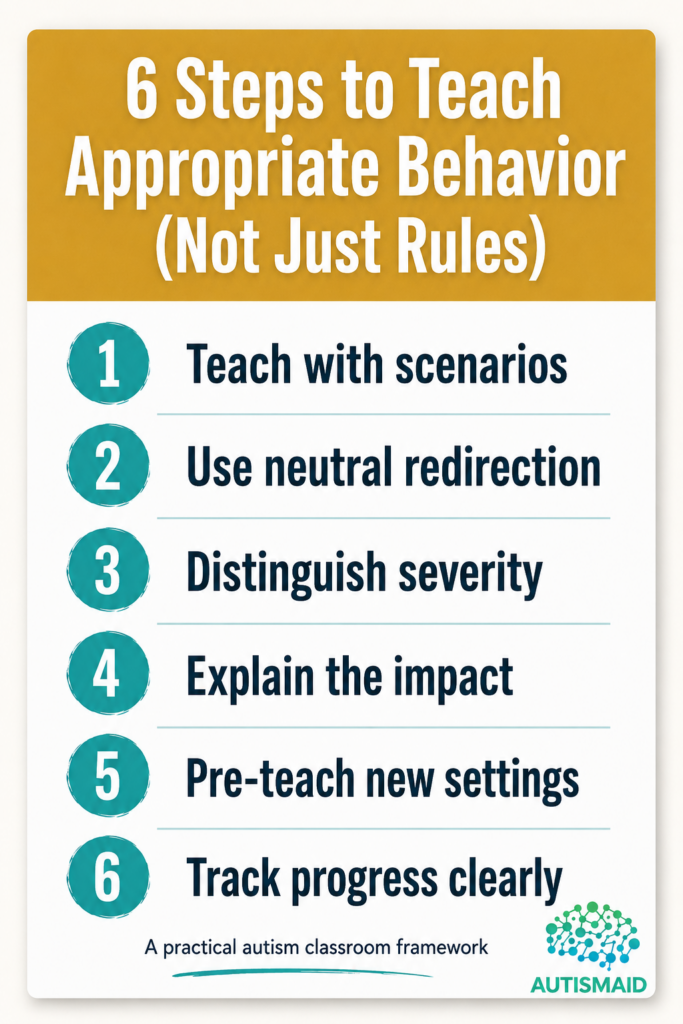
- Teach it explicitly, with scenario-based instruction. Present situations and ask the student to evaluate and explain appropriateness — this builds reasoning, not just categorization, which a posted rule can’t do on its own.
- Redirect with neutral, non-shaming language. “That behavior was inappropriate here — what would be appropriate instead?” separates the behavior from the student’s identity every time. Caveat: reserve “inappropriate” for genuinely social or safety-relevant moments — over-labeling every minor behavior flattens the concept and undoes the nuance you’re trying to build.
- Distinguish levels of severity. Mildly awkward, socially harmful, and seriously unsafe are different categories that need different responses — treating them identically is one of the fastest ways a framework stops being useful.
- Debrief the impact, not just the label. “How did that behavior affect others? That’s why it was inappropriate” connects the judgment to something the student can actually reason about next time, rather than a rule they’re expected to recall.
- Pre-teach before high-variance events. Assemblies, excursions, substitute teachers, and new staff all carry different — often unstated — standards. Pre-teaching the specific expectations before these events prevents the “the rule didn’t cover this” gap.
- Document it as a measurable skill. Appropriate/inappropriate behavior awareness is trackable — log instances of self-correction and independent identification in IEP progress notes rather than only logging incidents.
Takeaway: Run this framework end to end for one recurring behavior before adding a second — a fully taught judgment generalizes; a partially taught one just adds another rule to the pile.
Classroom Ideas
- Build a classroom Appropriate vs. Inappropriate anchor chart tied to your specific behavioral expectations, not a generic rule list — and involve students in generating it, since ownership increases how often they apply it.
- Run social thinking groups where students evaluate scenario cards together — peer discussion of the reasoning is often more persuasive than adult explanation alone.
- Use sorting cards as a low-stakes, repeatable practice format across settings (classroom, community, digital) so the judgment gets rehearsed outside of live incidents.
- Keep redirection private, not in front of peers — labelling a behavior as inappropriate publicly teaches shame, not judgment.
- Address digital behavior as its own explicit topic in class discussions — online settings remove the social feedback that normally flags inappropriate behavior, so it doesn’t transfer automatically from in-person teaching.
For Parents at Home: The language you use at school matters more when it matches what happens at home. Ask your child’s teacher what specific phrases they use to redirect (“Is that appropriate here?”) and use the same wording — consistency across both settings is what makes the framework something a child can actually rely on, rather than two different sets of rules to keep straight.
Takeaway: Any classroom strategy that only works while you’re standing next to the student is managing the moment, not building the skill — swap it for one that gives the student practice reasoning independently.
Home Ideas
For the parents who land on this page: the same principle applies at home. Use specific, neutral language (“that behavior was inappropriate here,” not “you’re being bad”), explain the impact rather than just the label, and always pair a correction with an appropriate alternative — “instead of X, you could try Y.” A short end-of-day routine — two appropriate things you did today, one thing to work on — builds the same self-monitoring habit your child’s teacher is building in the classroom.
Takeaway: If home and school use the same three moves — name the behavior, explain the impact, offer the alternative — your child only has to learn the framework once.
One Resource Block
You’ve got the framework and the classroom moves — here’s the classroom-ready version of everything above. The Classroom Appropriate Vs Inappropriate Behaviors set is built specifically for the in-context scenario evaluation Step 1 asks for, formatted for direct classroom use with guided-discussion structure built in. Pair it with the Appropriate Vs Inappropriate Behaviors task cards (80 cards, PDF and digital) for additional multi-setting practice once the classroom scenarios are established.
If you’re setting up the full instructional arc — anchor chart through daily tracking — the Appropriate Vs Inappropriate Behaviors Bundle (room cards, task cards, sorting cards, social stories, behavior trackers) covers introduction through reinforcement in one purchase.
Takeaway: Start with the classroom-specific set for Step 1’s scenario work, then add the trackers from the bundle once you’re at Step 6’s documentation stage.
Related Skills
- Basic Safety Awareness (prerequisite) — distinguishing safe from unsafe behavior is the most critical layer underneath appropriate vs. inappropriate judgment; teach this first if a student is still missing it.
- Personal Space and Touch (basic) (prerequisite) — appropriate touch and proximity are core components of this skill; body-safety awareness needs to be in place before the broader framework will hold.
- Problem-Solving Steps (follow-up) — once a student can identify that a behavior was inappropriate, problem-solving steps give them a process for figuring out what to do differently next time.
- Peer Pressure (follow-up) — resisting peer pressure to engage in inappropriate actions draws directly on this same judgment, applied under social pressure.
Pillar Guide: Teaching Appropriate vs. Inappropriate Behavior to Autistic Children: A Complete Guide
Check out our Classroom Appropriate Vs Inappropriate Behaviors"
Takeaway: If a student is stalling on this skill, check Basic Safety Awareness and Personal Space and Touch first — they’re the prerequisites most likely to be the real gap.
FAQ
Why doesn’t posting classroom rules stop repeated inappropriate behavior? A posted rule states the expected behavior but doesn’t teach the reasoning behind it — the impact on others, the safety risk, the social discomfort. Without that reasoning, the rule has nothing to generalize from when the next, slightly different situation comes up.
How do I teach appropriate behavior in my autism classroom? Use explicit, scenario-based instruction rather than repeated reminders: present a situation, ask the student to evaluate and explain it, debrief the real impact, and always pair the correction with an appropriate alternative.
How do I redirect inappropriate behavior without shaming a student in front of peers? Use private, neutral redirection — “that behavior was inappropriate here, what would be appropriate instead?” — rather than labelling the behavior publicly. Separate the behavior from the student’s identity every time.
How do I pre-teach appropriate behavior before assemblies, substitutes, or field trips? Walk through the specific, often-unstated expectations of the new setting before the event happens, rather than assuming standards from the regular classroom will transfer automatically.
What are good IEP goals for appropriate vs. inappropriate behavior? Because this skill has observable, trackable indicators — correctly identifying a scenario, explaining impact, self-correcting before adult intervention — it can be logged as a measurable goal with real progress data rather than a vague behavior target.
What classroom visual supports help with appropriate vs. inappropriate behavior? An anchor chart tied to your classroom’s specific expectations, plus sorting cards for repeated low-stakes practice, give students a reference they can use without needing to ask an adult in the moment.
How is appropriate vs. inappropriate behavior different from expected vs. unexpected behavior? Appropriate vs. inappropriate is a deeper layer built on the expected/unexpected framework — a student generally needs to grasp that behavior differs by context before they can evaluate it against appropriateness standards like safety and social impact.
Takeaway: If you only implement one answer from this list, make it the pre-teaching one — it prevents more incidents than any after-the-fact correction ever will.